Delegation and Agentic for Everyone
Over the last couple of weeks, I’ve been designing a course tentatively titled - “Agentic for Everyone” and thinking about how managers delegate work and what that might teach us about working with agents.
Agents & Delegation
I spent some time this week discussing with a colleague about delegation and how someone who has been a manager has probably had the chance to learn this skill. And more importantly - how the ability to delegate might actually make one more successful with Agents. The discussion brought together multiple research papers that I read recently and I wanted to reflect on that.
I struggled a lot when I first became a manager. Nobody told me that I was actually starting a completely new role from scratch where I actually did not have the necessary skills. On the contrary, I thought I was promoted because I excelled in the technical skills that I had and becoming a manager was the reward. Thankfully, I learnt from my peers that my role had evolved from from doing the task to delegating it to other team members and focussin on coordinating activities with other managers and the company leadership. The success in this new position was based on knowing which tasks to delegate and to determine whether the task had been done to your satisfaction. The reason you don’t do the work yourself (even though you can) is because you are trying to free up time to do different things; things that you or the organization perceives to be more valuable. This could be to come up with new business ideas or improvements in existing processes. The clear trade-off is between doing all the tasks yourself versus doing more rewarding tasks. It’s important to recognize the motivation for delegation because the process of delegation can take longer than expected with multiple feedback loops. It helps you to justify the energy and determination rather than fall back on the default mode of doing a task yourself.
Now that we have understood the concept of delegation, let’s come to how that works in the case of AI Agents. The process of delegation to a colleague or team member is tough. You need to communicate the context that is in your mind and also provide the higher-level objective that you are aiming for. You also need to build a judgement of the skill level and capabilities of the team member to whom you are delegating and adapt the information based on that. The concept of “Theory of Mind” is often used to describe this method of interaction. You form an opinion of the mind of the team member and adapt the way you communicate and interact with them in order to ensure that they understood what you meant and ensure the task is done. A working paper (Quantifying Human-AI Synergy by Riedl and Weidmann) has found that those same skills also apply to working with an LLM. Users who thought of the LLM as an “entity”, and formed an understanding of how it thinks and works (elicited based on prompts they use) were more successful in getting the desired output. The study shows that the way one works with team members to communicate and delegate tasks should be similar to the approach of working with AI agents. Build an understanding of how the AI agent works, start communicating the context in a way that allows the agent to work and find a way to indicate how the output would be verified or used.
This obviously brings us to the question of who actually is successful at doing this well? A recently published research paper on AI adoption (Delegating to AI: Beliefs and the Organization of Work at New Ventures by Colaiacovo and Koning) asked founders of new, still small companies how much AI had helped them. What was interesting is the way in which it elicited the opinion with the help of a counter-factual question. The researchers first established whether the founder was actually using AI to get work done and then followed up with the question - How many more employees would you have needed if you didn’t use AI at all? And the distribution of answers was the interesting finding. Nearly a third of founders said they would need no additional employees at all - essentially meaning that the use of AI didn’t actually save them from hiring any new team members, and the median founder estimated needing only 17% more headcount. However, the average estimate was much higher at 55%, pulled up by a smaller group of founders who said that they would have needed dramatically larger teams if they hadn’t used AI. The authors indicate that this smaller cohort of founders have worked to integrate AI into their workflows extremely well - delegating large aspects of their work to their AI team. Most founders have still not been able to trust and delegate to AI systems with confidence and seem to predominantly use it as chatbots.
Putting together what I’ve learnt - your ability to delegate more tasks to AI agents is driven by your motivation on why you’re doing it. What do you think is the best use of your time and what other high-value task are you going to chase because you have a higher cognitive capacity? After that you need to build the necessary confidence to delegate and trust the work of AI agents by leveraging Theory of Mind and going through the tedious process of delegation. You cannot build a Theory of Mind about a worker whose work you never see.
Showing the Work
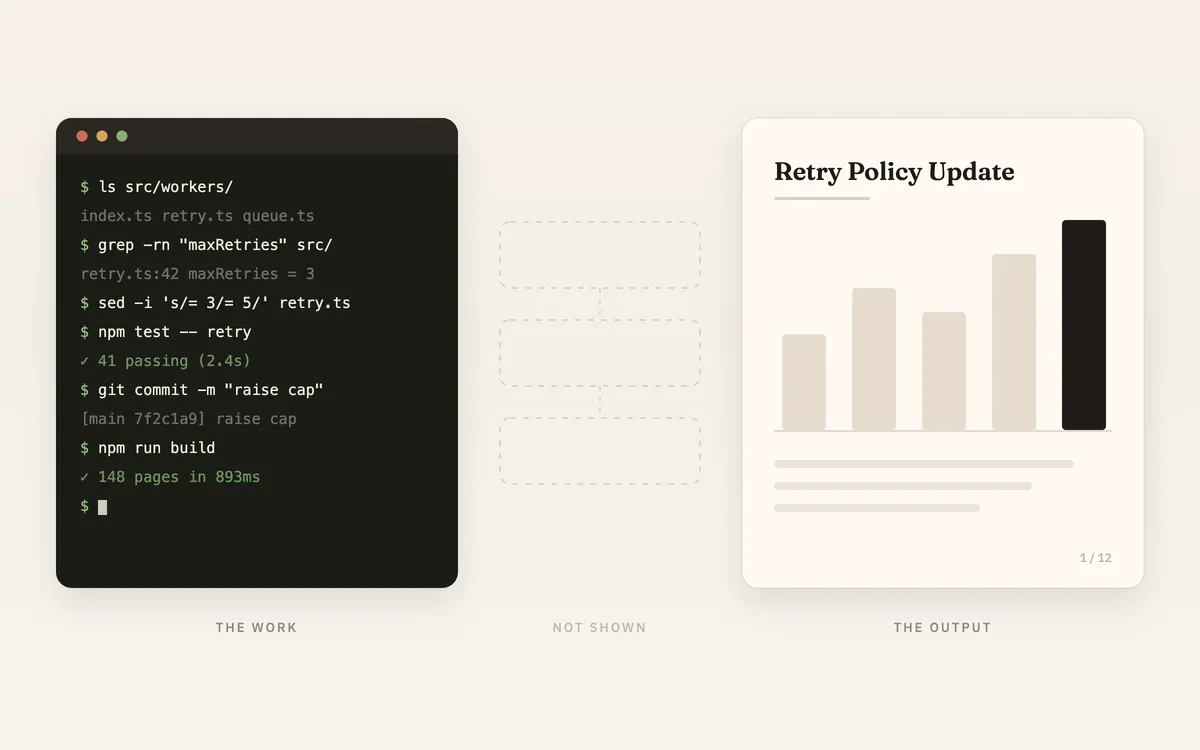
I thought back to my own experience of using the Claude Code CLI inside the terminal for the first time. I was amazed to see it running bash commands, writing local python files, running grep and sed commands to identify specific lines of files - these are all commands or steps that I have run myself before, so I could recognize them. But I was wowed because I was not writing them but Claude was. I was not executing them but the harness was! This was the moment where I saw the AI do what I would have normally done but way faster and still getting the steps and the final result right. And I guess this is specific to me because I understand how to operate the terminal and know those commands. So what does this experience look like for regular business users who use a whole bunch of professional tools on a regular basis?
I had the chance this week to interact with colleagues from various departments across the IT landscape - folks who issue laptops, reply to IT helpdesk tickets and react to incidents. My goal was to help them identify how or where AI might be integrated into their daily work. I went into the workshop prepared to talk about coding agents that can react to incidents, do the initial investigation by scanning logs, analyzing application/ infrastructure/ network status and present a first report to the human operator. This would require only read access and can be run in a secure sandbox. But I very quickly realized that many folks in the audience had not really seen what a coding agent is and what it can do. And I found it extremely hard to explain this concept without showing it. And showing Claude Code working on a local repository in a black terminal window - that’s not something this audience might understand or appreciate.
I would have expected my ideas to fail because read access to ServiceNow is not allowed but I lost the battle even earlier. I could not get the group excited about the solution. And that made me think of the larger question - how does one illustrate the power of an agent in a manner that grabs the attention of folks and in a way that they understand and comprehend. How might I replicate my own Claude Code moment for them.
Most knowledge workers still work predominantly in GUI applications or web browsers. The most common being Outlook, Teams/ Slack for communication. And beyond that office tools like Word, Excel & PowerPoint and other task-specific tools like ServiceNow or Adobe Creative Suite. However, the most common Agent interface today is a chat window within native AI apps like Claude Cowork or the new ChatGPT Codex app. It could also be a chat interface inside existing apps like Copilot in the Microsoft Office suite. The way it works is that you need to do some initial setup inside the AI apps by connecting your mail and calendar (via plugins/connectors) and most of these tools are able to natively generate and render Word documents and PowerPoint presentations. But these work outputs are often presented as the final product, which you download and adapt as you wish. What you don’t see or experience is what it actually does. You don’t see the commands it’s running, how it organized the various elements on the slide or whether it picked from various titles.
This is because of how the coding agents work - often directly with the underlying APIs and very rarely with Computer Use - which is still clunky when it works. So the regular worker sees the final outcome but not how the agent thinks or steps it took to create it. What I wonder is whether this interface or presentation is sufficient for knowledge workers to start trusting the work of agents and delegating work to them? Do these tools enable users to build a “Theory of Mind” about AI? What can be done within the tool or via training that allows knowledge workers to experience the power of an agent. I’m in the process of designing a course titled “Agentic for Everyone” and trying to figure out the best way to illustrate how an Agent actually works, when to trust it and then delegate with confidence. I am shaping this course to illustrate the use of specific AI tools but more crucially to learn how to adapt your mindset, thinking and approach to working and delegating to agents.